YouTube turned 20 in 2025 and spent the anniversary doing what it has done every year: growing. The platform that started as a place to share grainy home videos now has the largest active app user base among the top social and video apps, the biggest share of US TV viewing of any media distributor, and a business that brought in more than $60 billion in 2025. In 2026, the numbers behind YouTube tell a story of sustained scale and evolving creator economics. Here are the statistics every marketer, creator, and digital strategist needs to know.
1. YouTube Ads Reach At Least 2.53 Billion Users
According to Google’s own ad planning data, compiled by DataReportal, YouTube ads reached 2.53 billion users in January 2025, which ranks it first among social platforms by ad reach. For comparison, Facebook ads reached 2.28 billion users in the same period. Ad reach is not the same as total monthly users, so YouTube’s true audience is likely larger than this figure.
The biggest single market is India, with 491 million YouTube users, followed by the United States with 253 million and Brazil with 144 million. This geographic spread means YouTube’s audience is becoming more diverse linguistically and culturally, which has pushed YouTube to invest in tools like AI auto dubbing, used on more than 20 million videos in its first six months.
2. Users Watch Over 1 Billion Hours of Video Every Day
Daily watch time on YouTube passed 1 billion hours back in 2017, and by 2024 viewers were watching more than 1 billion hours a day on TV screens alone. To put 1 billion hours in perspective: watching that much video back to back would take roughly 114,000 years. This volume of daily consumption makes YouTube one of the most significant media channels in the world, and in the US it now captures 14.2% of all TV viewing time, a record set in July 2026.



Recommendations do much of the work. In 2018, YouTube said about 70% of watch time came from its recommendation system rather than search. When a viewer clicks on a recommended video, the platform’s machine learning system has correctly predicted what that person wants to watch next, which is a remarkable achievement given the diversity of the user base and the sheer volume of content available.
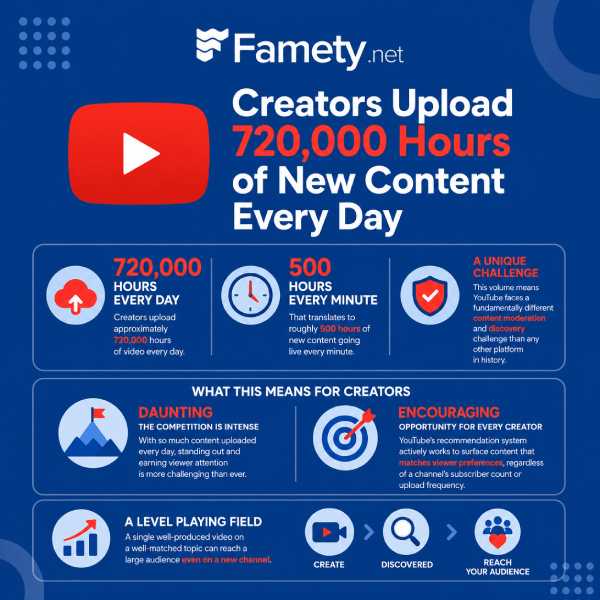
3. Creators Upload Over 20 Million Videos Every Day
The supply of new YouTube content is staggering. As of April 2025, more than 20 million videos were uploaded to YouTube on an average day, and the platform had passed 20 billion uploaded videos in total. The last time YouTube shared an hours figure, in 2019, it was more than 500 hours of content uploaded every minute. This volume means that YouTube faces a fundamentally different content moderation and discovery challenge than any other platform in history.
For creators trying to build an audience, this supply figure is both daunting and encouraging. Daunting because the competition for viewer attention is intense; encouraging because YouTube’s recommendation system actively works to surface content that matches viewer preferences, regardless of a channel’s subscriber count or upload frequency. A single well-produced video on a well-matched topic can reach a large audience even on a new channel.
4. YouTube Generated $40.37 Billion in Advertising Revenue in 2025
YouTube’s advertising revenue reached $40.37 billion in 2025, up from $36.15 billion in 2024, according to Alphabet’s annual report. Alphabet also said YouTube’s revenue across ads and subscriptions exceeded $60 billion for the full year. Ad revenue in Q4 2025 alone was $11.38 billion.
The advertising business breaks down into several distinct formats: skippable in-stream ads, non-skippable in-stream ads, in-feed video ads, bumper ads, masthead ads, and Shorts ads. The mix of formats gives advertisers flexibility to optimize for brand awareness, consideration, or direct response depending on campaign objectives. Alphabet’s 10-K notes that 2025 growth was driven by direct response advertising, followed by brand advertising.
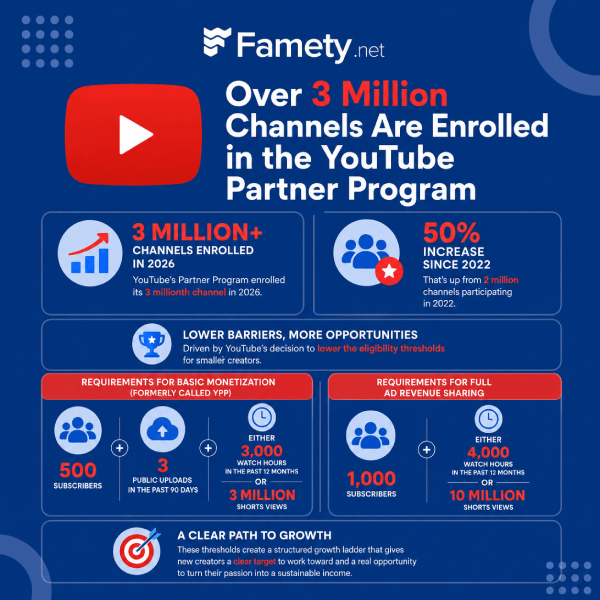
5. Over 3 Million Channels Are Enrolled in the YouTube Partner Program
YouTube’s Partner Program, which allows creators to monetize their content, had more than 3 million channels as of early 2024, the most recent official count. That is a 50% increase from the 2 million creators in the program in August 2021, helped by YouTube’s decision to open earlier access to smaller creators.
The current entry requirements for YPP fan funding features (memberships, Supers, Shopping) are 500 subscribers, 3 public uploads in the past 90 days, and either 3,000 watch hours in the past 12 months or 3 million Shorts views in the past 90 days. For ad and Premium revenue sharing, the thresholds are higher: 1,000 subscribers and 4,000 watch hours in 12 months or 10 million Shorts views in 90 days. These thresholds create a structured growth ladder that gives new creators a clear target to work toward.
6. YouTube Paid Over $100 Billion to Creators in Four Years
YouTube says it paid over $100 billion to creators, artists, and media companies in the past four years, through ad revenue sharing, YouTube Premium, channel memberships, Super Chats, Super Thanks, and shopping features. YouTube also states that YPP has paid out more than any other creator monetization platform.
Ads are not the whole story for successful channels. According to YouTube, more than 50% of channels earning five figures or more had revenue from sources other than ads and Premium, and channel memberships grew over 40% in 2024. Earnings are still unequal: a relatively small number of high-performing channels capture a disproportionate share of views, and views drive the ad revenue that determines most creators’ earnings.
For a per-video translation of those figures, the math looks very different for a small channel asking how much YouTube pays for 20K views than it does at the very top end of the creator economy, where the question is how much YouTube pays for 1 billion views.
7. TV Has Surpassed Mobile as the Top US Watch Surface
In February 2025, YouTube CEO Neal Mohan said TV had surpassed mobile as the primary device for YouTube viewing in the US, measured by watch time. eMarketer forecasts that over 180 million people in the US will watch YouTube on connected TVs in 2026, a milestone that fundamentally changes how brands should think about YouTube advertising. DataReportal reports that CTV ads can reach 84.6% of YouTube’s total US audience.
CTV viewing behavior differs from mobile viewing. Viewing is often shared with other household members, and for more than half of the top 100 most-watched channels globally, TV is the primary screen. For advertisers, CTV YouTube placements behave more like traditional television advertising in terms of household reach, but with digital-level targeting and measurability.
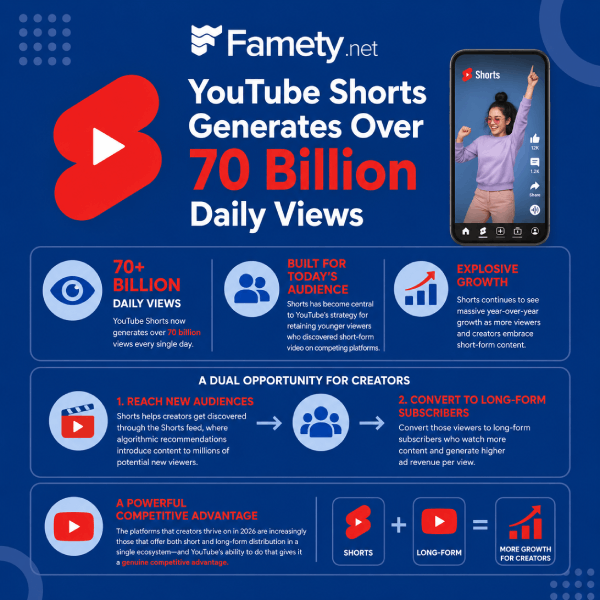
8. YouTube Shorts Generates Over 200 Billion Daily Views
YouTube Shorts, the platform’s short-form video format competing directly with TikTok and Instagram Reels, now averages 200 billion daily views, up from over 70 billion in early 2024. The format has become central to YouTube’s strategy for retaining younger viewers who discovered short-form video on competing platforms.
For creators, Shorts presents a dual opportunity: reach new audiences who discover content through the Shorts feed, then convert those viewers to long-form subscribers who generate higher ad revenue per view. The platforms that creators thrive on in 2026 are increasingly those that offer both short and long-form distribution in a single ecosystem, and YouTube’s ability to do that is a genuine competitive advantage.
9. India Is YouTube’s Largest Market by User Count
India is YouTube’s single largest market by number of users, with 491 million users compared with 253 million in the United States, based on Google’s ad reach data for January 2025. Growth there has been driven by affordable mobile data, regional-language content, and a creator ecosystem that has matured rapidly over the past several years.
Brands targeting Indian consumers should plan for a mobile-first, multilingual audience. Note that the lightweight YouTube Go app, once popular on low-end Android phones in India, was discontinued in August 2022; Google said the main YouTube app had been improved for low-end devices and slower connections.
10. YouTube Music and Premium Have Over 125 Million Subscribers
YouTube Music and Premium reached over 125 million subscribers, including trials, in March 2025, up from 100 million in early 2024. In Q1 2026, Alphabet said Music and Premium had their largest quarterly increase in non-trial subscribers since launch, but did not share a new total. Premium provides ad-free viewing, background playback, and offline downloads across YouTube, YouTube Music, and YouTube Kids.
Premium subscribers represent a valuable audience segment for creators beyond just ad revenue. When a Premium member watches a video, YouTube shares that member’s monthly fee with creators based on how much of their content is watched, rather than paying from ads. Downloaded and background-played views count toward that watch time.
What These YouTube Statistics Mean for Creators and Marketers in 2026
The TV milestone may be the most strategically important data point in this list. It signals that YouTube has completed its transition from a supplementary digital channel to a primary household screen, competing directly with streaming services like Netflix and Disney+ for living room attention. YouTube has been number one in US streaming watch time for nearly three years, according to Nielsen. For brands, this means YouTube’s inventory should be evaluated alongside CTV buys rather than purely as a social media placement.
For creators, Partner Program growth from 2 million to more than 3 million channels, combined with over $100 billion paid out in four years, confirms that YouTube remains the most economically viable creator platform at scale. The challenge in 2026 is not access to monetization but competition for attention: getting discovered among more than 20 million new videos a day requires genuine content differentiation and strategic use of both Shorts and long-form video.
YouTube doesn’t exist in isolation. The same audiences that watch over 1 billion hours of YouTube per day also stream music: Spotify statistics for 2026 show how audio and video consumption patterns overlap, which matters for any creator building cross-platform reach. For social discovery, essential Twitter statistics reveal how conversation volume drives YouTube traffic at the top of the funnel.
Frequently Asked Questions About YouTube in 2026
How many users does YouTube have in 2026?
Google’s ad data shows YouTube ads reached at least 2.53 billion users (January 2025), the highest ad reach of any social platform. YouTube does not publish an official monthly active user figure.
How many hours of video are watched on YouTube every day?
YouTube users watch over 1 billion hours of video every day, and more than 1 billion hours a day on TV screens alone. YouTube said in 2018 that about 70% of watch time comes from recommendations.
How much does YouTube pay creators?
YouTube paid over $100 billion to creators, artists, and media companies in the past four years. Individual earnings vary widely by niche, audience location, and format.
How many channels are in the YouTube Partner Program?
More than 3 million channels are in the YouTube Partner Program, according to YouTube’s most recent count (2024), up from 2 million in 2021.
How many views do YouTube Shorts get per day?
YouTube Shorts averages 200 billion daily views, making it one of the most-watched short-form video platforms globally.
Grow Your YouTube Channel with Famety
YouTube’s scale is an opportunity, but only if your channel has the visibility to participate. Famety provides targeted growth services that help creators and brands build the early momentum that YouTube’s algorithm rewards.
Subscriber count is the metric that determines your eligibility for monetization and signals authority to new visitors. Explore YouTube Subscribers to grow your channel with real, engaged subscribers who improve your long-term metrics.