Spotify launched in 2008 with a simple pitch: unlimited music, right now, no downloads required. Nearly two decades later, it sits at the center of how the world listens. Whether you are an artist trying to get your music heard, a marketer deciding where to spend your budget, or simply a curious reader, the platform’s latest numbers tell a story worth knowing. Here are the 10 Spotify statistics that define the platform in 2026.
1. Spotify Has Reached 777 Million Monthly Active Users
In its Q2 2026 results, Spotify reported 777 million monthly active users worldwide, up 12% year over year. Spotify describes itself as the world’s most popular audio streaming subscription service, and it holds the largest share of music subscribers of any service (see statistic 3).
To put that number into perspective: with a world population of about 8.3 billion, that is close to 1 in every 10 people on Earth opening the app at least once a month. The growth is not slowing down either. In 2025, MAUs in Spotify’s “rest of world” region, which covers markets outside Europe, North America, and Latin America, grew 21% year over year, the fastest of any region, with Latin America next at 10%.
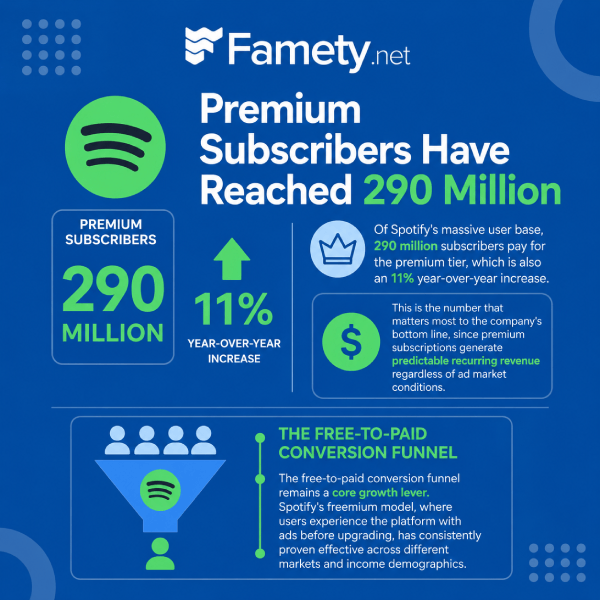
2. Premium Subscribers Have Reached 300 Million
Of Spotify’s massive user base, 300 million subscribers paid for Premium at the end of Q2 2026, a 9% year-over-year increase. This is the number that matters most to the company’s bottom line, since Premium subscriptions generate predictable recurring revenue regardless of ad market conditions.



The free-to-paid conversion funnel remains a core growth lever. Spotify says its ad-supported tier serves as a funnel, driving a significant portion of its gross Premium subscriber additions. Brazil is one example: at its 2026 Investor Day, Spotify said its conversion rate there had doubled to 44% since 2016.
3. Spotify Holds 31.4% of Global Music Subscriptions
According to MIDiA Research, Spotify held 31.4% of the world’s 921.6 million music subscriptions at the end of 2025, which keeps it comfortably ahead of its closest competitors. Tencent Music followed with 13.8%, Apple Music with 12.6%, YouTube Music with 12.4%, and Amazon Music with 8.5%. No other service comes close to matching Spotify’s reach at scale.
This dominance gives the platform enormous leverage with record labels, podcast publishers, and independent creators alike. When a single platform commands nearly a third of all global music subscriptions, the algorithmic decisions it makes about what to surface and what to suppress carry real consequences for artists and their careers.
4. Annual Revenue Crossed the EUR 17 Billion Mark
Spotify generated EUR 17.2 billion in revenue during 2025, up 10% on 2024, along with EUR 2.2 billion in operating income. That marks its transition from a high-growth, money-losing startup into a genuinely profitable media company. The fourth quarter of 2025 alone brought in EUR 4.5 billion, a 13% year-over-year increase at constant currency, and Q2 2026 revenue reached EUR 4.8 billion, up 14%.
The revenue mix has shifted meaningfully. Advertising still matters, but Premium subscriptions made up 89% of total revenue in 2025, while ad-supported revenue slipped 1% for the year. That reliance on subscriptions insulates the business from the kind of volatility that hits ad-supported platforms during economic downturns.
5. Users Streamed 211 Billion Hours of Content in 2025
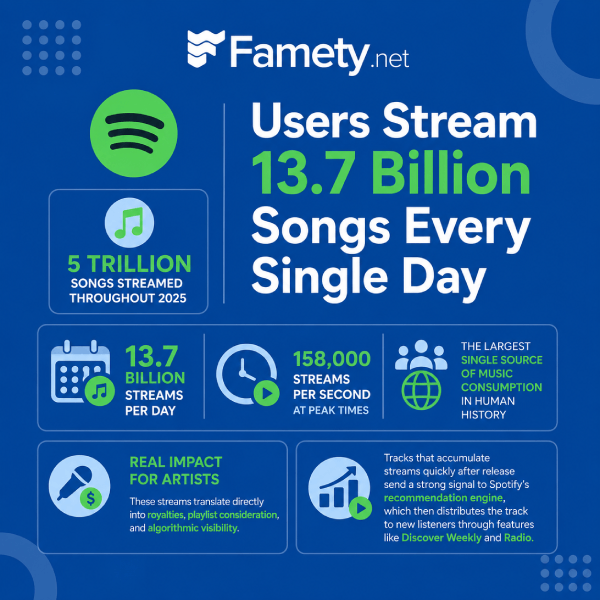
Spotify’s audience streamed 211 billion hours of content in 2025, an 11% increase on 2024. That works out to roughly 578 million hours of listening and watching every day. For wider context, Luminate counted 5.1 trillion on-demand music streams across all streaming platforms worldwide in 2025, and Spotify is the largest single service in that market.
For artists, these streams translate directly into royalties, playlist consideration, and algorithmic visibility. Tracks that accumulate streams quickly after release send a strong signal to Spotify’s recommendation engine, which then distributes the track to new listeners through features like Discover Weekly and Radio.
6. Spotify Is Available in 184 Markets
Geographic availability has always been one of Spotify’s competitive advantages. The platform operates in 184 countries and territories, giving it a distribution network that most competitors cannot match. That reach is particularly valuable for independent artists who want their music accessible to listeners worldwide without navigating individual country-level licensing agreements.
Europe is Spotify’s largest region, with 26% of MAUs at the end of 2025, followed by Latin America at 21% and North America at 16%. The remaining 37% sit in the “rest of world” region, which is growing fastest. India is a clear example: Spotify said at its 2026 Investor Day that its subscriber count there has grown sevenfold since its previous Investor Day.
7. The Library Contains More Than 100 Million Tracks
Spotify’s catalog has grown beyond 100 million tracks, covering virtually every genre, language, and era of recorded music. For context, at an average of three to four minutes per track, a listener would need roughly 600 years of continuous listening to hear every track in the library once.
The sheer size of the catalog creates both an opportunity and a challenge. More music means more discovery potential, but it also means that most tracks receive almost no streams at all. Luminate found that across streaming services, nearly half of the 253 million tracks available in 2025 got fewer than 10 streams, while just 541,000 tracks accounted for 49.4% of all consumption. That gap underlines how much algorithmic placement and editorial curation matter for artists trying to build an audience.
8. Spotify Hosts 7 Million Podcast Titles
Spotify made a major strategic bet on podcasting beginning in 2019, acquiring studios, technology companies, and exclusive deals with high-profile creators. That investment has produced results: the platform now hosts 7 million podcast titles, making it one of the largest podcast distribution platforms in the world. Spotify said in May 2026 that podcasts were in their second year of profitability.
Podcasting matters to Spotify’s business because it gives listeners another reason to open the app every day. More listening time means more ad inventory and deeper habits that keep subscribers from canceling their Premium plans. It also opens up a monetization category, podcast advertising, that operates somewhat independently from music licensing costs.
9. Gen Z Makes Up 35% of Spotify’s Audience
Spotify skews young. According to Spotify’s own Culture Next 2026 report, Gen Z makes up 35% of its audience and spends two hours a day streaming. The same pattern shows up in newer formats: Spotify says almost half of its audiobook listeners are under 35.
For brands, this demographic concentration means Spotify advertising reaches an audience that is genuinely difficult to reach through conventional channels like traditional radio. Spotify reported that its number of active advertisers was up 68% year over year in Q1 2026, a sign that more brands are testing the channel.
10. Spotify Wrapped Drives Massive Year-End Engagement
Spotify Wrapped, the annual personalized listening recap that the platform releases each December, has become one of the most talked-about social media moments of the year. Wrapped 2025 reached more than 200 million engaged users in its first 24 hours, and by the end of the campaign it had more than 300 million engaged users and over 630 million social shares in 56 languages.
Beyond being a fun product feature, Wrapped is a masterclass in viral growth. It transforms passive listeners into active promoters who share their data publicly, putting the Spotify brand in front of new audiences at minimal cost. For artists, a strong Wrapped showing can translate directly into increased streams, new followers, and improved algorithmic positioning heading into the new year. Wrapped favors artists who already have listeners coming back, which is why growing your Spotify followers before the end of the year pays off when the campaign starts.
What These Spotify Statistics Mean for Artists and Marketers in 2026
The numbers above point to a platform that is growing steadily, generating real profit, and sitting at the center of how music reaches listeners globally. For artists, the key takeaway is that scale matters: with 211 billion hours streamed in a year across more than 100 million tracks, the difference between algorithmic visibility and obscurity can come down to early release momentum, playlist placement, and consistent engagement signals.
For marketers, Spotify’s young, Gen Z heavy audience and its expanding podcast ecosystem represent an increasingly attractive channel for brands that need to reach audiences who have largely moved away from traditional broadcast media.
For a cross-platform view of that same audience, the essential Twitter statistics for 2026 show how social conversation volume and real-time engagement compare to Spotify’s passive listening model. The overlap between the two platforms’ core demographics is significant for any brand strategy that spans audio and social.
Frequently Asked Questions About Spotify in 2026
How many monthly active users does Spotify have in 2026?
Spotify had 777 million monthly active users at the end of Q2 2026, representing 12% year-over-year growth.
How many premium subscribers does Spotify have?
Spotify had 300 million Premium subscribers globally at the end of Q2 2026, up 9% year over year.
What is Spotify’s market share in music streaming?
Spotify held 31.4% of global music subscriptions at the end of 2025, according to MIDiA Research, ahead of Tencent Music at 13.8%, Apple Music at 12.6%, YouTube Music at 12.4%, and Amazon Music at 8.5%.
How much revenue did Spotify generate?
Spotify generated EUR 17.2 billion in revenue in 2025, with Q4 2025 alone reaching EUR 4.5 billion.
How many songs are on Spotify?
Spotify’s library contains more than 100 million tracks across all genres, languages, and eras, alongside 7 million podcast titles and 700,000 audiobooks.
Grow Your Spotify Presence with Famety
Understanding where Spotify stands in 2026 is one thing. Getting your own profile to grow within that landscape is another. Famety helps artists and creators build real momentum on the platform through targeted engagement services designed to support organic growth.
If you are looking to increase your stream counts and reach more listeners, explore Spotify Plays to give your releases the early boost that triggers Spotify’s recommendation algorithm.